One of the most common reasons an organization brings me into the interview process is because they need someone to tackle their onboarding curriculum. Sometimes I’m being asked to revitalize a curriculum that’s been gathering dust for years, and other times that means I’m finally formalizing a process that’s been left to managers and seasoned peers. Either way, I’m usually asked to describe what an onboarding overhaul looks like for their team.
The challenge, of course, is that most interviews last about 30 minutes, which not nearly enough time to ask thoughtful questions about existing content and walk through my entire approach. So I created this document as a follow-up resource I can share with potential employers. If you’re familiar with ADDIE, you’ll notice its foundations here.
Onboarding is often the first true learning experience a new employee encounters, and when done well, it sets the tone for everything that follows. A strong program builds early confidence, strengthens cultural alignment, and accelerates time-to-contribution in a role. Because onboarding touches every corner of an organization, designing it can feel daunting to many. Where do you start? Who should be involved? How do you balance the essentials of Day 1 with what can come later?
Over time, I’ve developed a clear, repeatable process that helps answer those questions and turns ambiguity into structure. The framework below is one I’ve used successfully across industries, team sizes, and organizational maturity levels. If you’re staring at a blank page and wondering where to begin, I hope this gives you a grounded place to start.
Step 1: Define the Objectives and Success Criteria.
Before anything else, we need clarity. Understanding why the onboarding exists and what outcomes it should drive anchors every decision that comes later.
I love using an impact map at this stage. It keeps the meeting conversational while still giving us a clear view of business goals, learner behaviors, and success measures. I typically devote an entire meeting to this activity, though it can also be completed asynchronously for busy SMEs and executives. And because it’s just one slide, it’s easy for leadership to engage with—even between chat notifications.
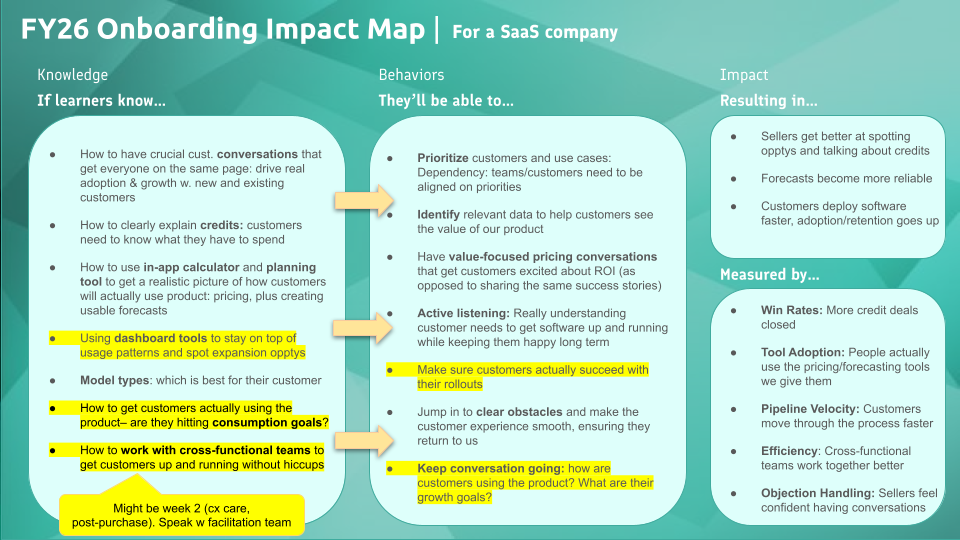
Key steps:
- Identify business goals (e.g., reduce ramp-up time, improve retention, ensure compliance).
- Align with stakeholders on performance expectations for the first 30/60/90 days.
- Draft measurable learning objectives that correspond to the business goals.
Outputs:
- A completed Impact Map, a purpose statement, learning objectives, success metrics, and clearly defined performance milestones.
Step 2: Conduct a Robust Needs Analysis
This is where the real detective work begins. Instructional Designers often hear, “We don’t have any training,” but that’s almost never true. Unless the organization is in its early, scrappy five-person days (and if they had the foresight to hire an ID that early—please introduce us!), someone has been training new hires informally.
Review What Teams Are Already Doing
When you ask what existing training, documentation, or tools you should reference, you may get: “Uhm… nothing. We got nothing.” But dig deeper. Early introductory materials often live in a manager’s Teams or Drive folder, embedded in onboarding emails, or tucked inside a long-forgotten slide deck. Talk to the boots-on-the-ground folks—the people actually showing new hires how things work. You’ll be surprised at what you uncover, and it will save you hours of re-creating content from scratch.
Map Out Required Systems and Access
It’s easy to lose track of the systems a new hire needs access to, especially when each department owns a different piece. To stay sane, create a systems checklist or flowchart based on three sources: IT’s new hire procedure, HR’s onboarding steps, and a running list of every system SMEs mention in your interviews. Combining these gives you a bird’s-eye view of what a new hire needs to log into on Day 1, and ensures nothing slips through the cracks.
Other key steps:
- Interview managers, SMEs, and recent hires.
- Identify required knowledge, skills, behaviors, and tools.
- Analyze existing processes and resources for gaps.
Outputs:
A competency map, an inventory of existing materials, and a prioritized list of needs.
Step 3: Design the Learning Journey
This phase is critical—and often the easiest for stakeholders to overlook. There are no polished slides yet, no interactive elements to “ooh” and “ahh” at. This is the storyboarding phase where we determine how learning will happen. Because reviews tend to be lighter here, having a strong stakeholder champion is invaluable.
During this phase, I map out the end-to-end onboarding experience, sequence content so it builds logically, and ensure new hires aren’t overwhelmed on Day 1. I’m a big fan of tools like Lucidchart for collaborative mapping; they make it easier for partners to visualize the flow and provide meaningful feedback.
Key steps:
- Break the journey into phases (Pre-boarding, Week 1, Days 1-5).
- Plan reinforcement moments and check-ins.
- Develop a review-ready flow for SMEs and stakeholders.
- Ask questions, collaborate, and be willing to revisit early decisions—this is the “measure twice” phase.
Outputs:
A learning journey map and structured curriculum outline.
A note on timelines:
When timelines are tight or SME engagement is limited, this is often the step where I make strategic cuts. Building modular content (pieces that can be rearranged or swapped) helps accommodate later changes without derailing the entire project.
Step 4: Develop the Content
Now we bring the plan to life. This is where instructional strategy meets design craft, and where a well-executed needs analysis pays off. Close partnership with SMEs ensures accuracy and keeps the content grounded in real practice. This is the stage where I integrate games or other reinforcement activities.
Key steps:
- Draft module-level learning objectives tied to performance outcomes.
- Build content in authoring tools and release drafts to SMEs/stakeholders
- Develop multimedia elements, job aids, and practice activities.
Outputs:
eLearning modules, facilitator/learner guides, slide decks, knowledge checks, and reference materials.
Another note on timelines:
Through experience, I’ve learned that subject matter expert availability can vary, so I adapt my approach to reviews accordingly. When SME time is limited, I use rapid development techniques such as sharing targeted review links and specific, focused questions asynchronously. When more support is helpful, I facilitate collaborative working sessions that allow for real-time review and live editing, ensuring accuracy while keeping projects moving forward.
Step 5: Implement and Enable Delivery
Now it’s time to deliver the learning experience to our learners. Implementation involves preparing facilitators, setting up learning environments, and ensuring the curriculum is accessible and functional. When possible, I always sit in on the first full run. By this stage, everything should run smoothly, and any necessary tweaks are usually small.
Key steps:
- Upload and test content within the LMS.
- Hold TTT sessions to establish clear expectations with facilitators, managers, and mentors.
- Create new-hire checklists, communication templates, and welcome pathways.
- Provide managers with guidance on how to support learners between sessions.
Outputs:
LMS-ready content, communication plans, and manager/mentor enablement materials.
What’s Next?
By the end of all this, I’ve designed a complete Onboarding program with the help of teammates, SMEs and stakeholders. The process is part science, part archaeology, and part design-thinking exercise. But we can’t stop here! No organization is static, and our training shouldn’t be either. Evaluating performance and experience over time keeps your curriculum relevant and effective.
I’m a fan of reviewing 30/60/90-day results, though I’ve adapted these checkpoints to match business rhythms like quarter-close or seasonality when needed. As updates arise, governance and version control become essential. Without them, even the best-designed curriculum can quickly drift into inconsistency.
When maintained well, onboarding becomes a powerful engine for engagement, confidence, and long-term success. This framework has served me and my clients for years, and I’m excited to bring it to your organization next.